
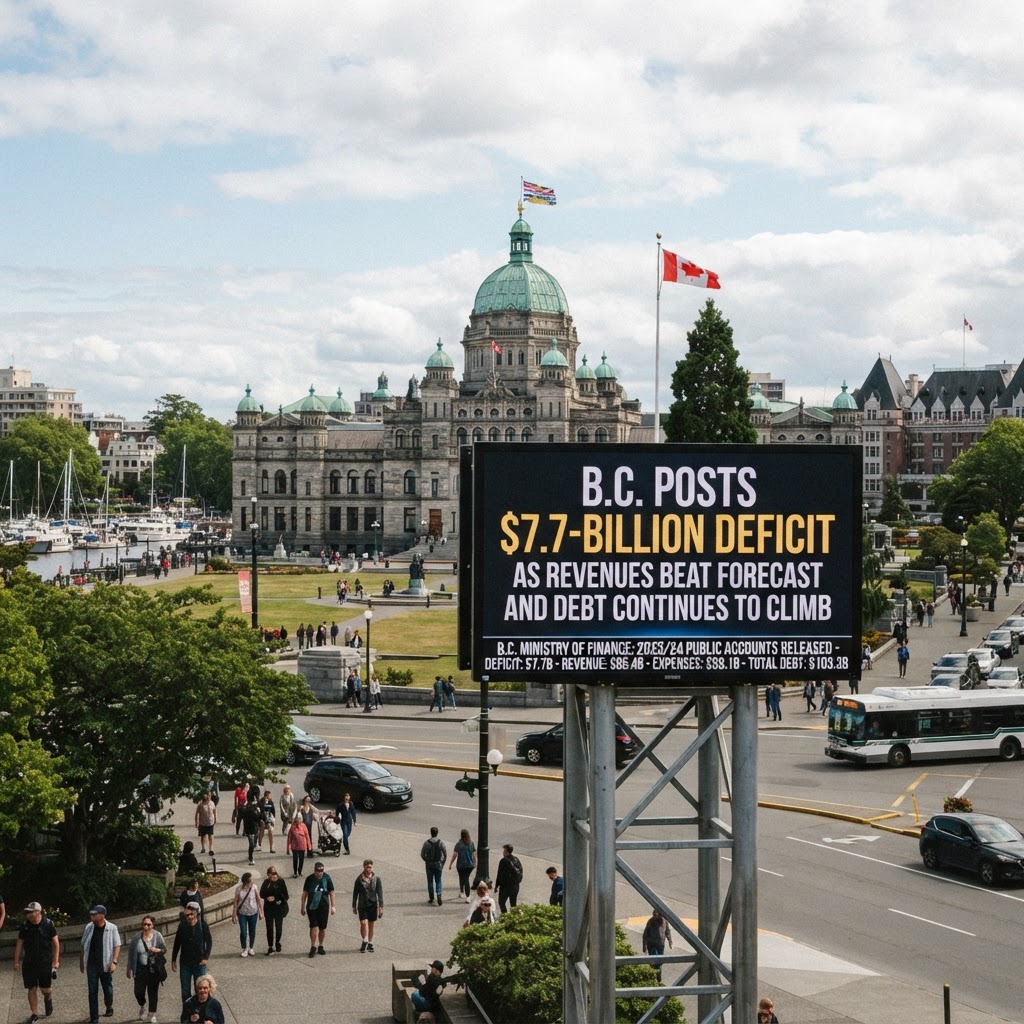
B.C. posts $7.7-billion deficit as revenues beat forecast and debt continues to climb
British Columbia finished the 2025-26 fiscal year with a $7.7-billion deficit, substantially smaller than the $10.9-billion shortfall projected when the provincial budget was introduced. Higher-than-expected revenue and lower spending helped improve the final result, although the province continued to add debt and recorded a slightly larger deficit than the previous fiscal year.
VICTORIA — B.C.’s newly released Public Accounts show the provincial government ended the fiscal year on March 31 with a deficit roughly $3.2 billion smaller than originally budgeted. Revenue finished $2.9 billion above the Budget 2025 estimate and $1.8 billion higher than the government’s third-quarter forecast, while expenses came in approximately $344 million below budget, largely because some contingency funding went unused.
A major contributor to the stronger revenue result was a one-time settlement with tobacco companies, which the Public Accounts valued at approximately $2.56 billion. Higher earnings from commercial Crown corporations, particularly ICBC, also contributed to the improvement. The tobacco payment means a significant portion of the improvement is non-recurring and will not provide the same revenue boost in future fiscal years.
Despite beating its budget forecast, the province’s underlying fiscal position continued to weaken compared with the previous year. The $7.7-billion deficit was approximately $353 million larger than the $7.3-billion deficit recorded in 2024-25. Taxpayer-supported debt increased by another $18.4 billion during the year, while the taxpayer-supported debt-to-GDP ratio climbed to 26.3%, compared with 23.2% a year earlier.
The province also continued a major infrastructure program, investing approximately $11 billion in taxpayer-supported capital projects, about $1 billion more than in the previous fiscal year. That included roughly $3.1 billion for health-care facilities, $4.1 billion for transportation infrastructure and $2.8 billion for K-12 schools and housing at post-secondary institutions. B.C.’s economy grew by 2% in 2025, exceeding the 1.8% growth forecast in Budget 2025, while employment grew 1.1% and the provincial unemployment rate averaged 6.2%.
The Public Accounts are the province’s audited year-end financial statements rather than a forecast, providing the final accounting of government finances for 2025-26. The Auditor General concluded that the consolidated financial statements fairly presented, in all material respects, the government’s financial position as of March 31, providing independent assurance over the reported results.
Share this article
Comments (0)
No comments yet. Be the first to share your thoughts!


